Saturday, December 5, 2009

The Function of the PHY - WiMAX

As the name might imply, the purpose of the PHY is the physical transport of data. The following paragraphs will describe different methods to ensure the most efficient delivery in terms of bandwidth (volume and time in Mbps) and frequency spectrum (MHz/GHz). A number of legacy technologies are used to get the maximum performance out of the PHY. These technologies, including OFDM, TDD, FDD, QAM, and Adaptive Antenna System (AAS), will be described in the following pages or chapters.

OFDM: The "Big So What?!" of WiMAX

OFDM is what puts the max in WiMAX. OFDM is not new. Bell Labs originally patented it in 1970, and it became incorporated in various digital subscriber line (DSL) technologies as well as in 802.11a. OFDM is based on a mathematical process called Fast Fourier Transform (FFT), which enables 52 channels to overlap without losing their individual characteristics (orthogonality). This is a more efficient use of the spectrum and enables the channels to be processed at the receiver more efficiently. OFDM is especially popular in wireless applications because of its resistance to forms of interference and degradation. In short, OFDM delivers a wireless signal much farther with less interference than competing technologies. Figure 1 provides an illustration of how OFDM works.

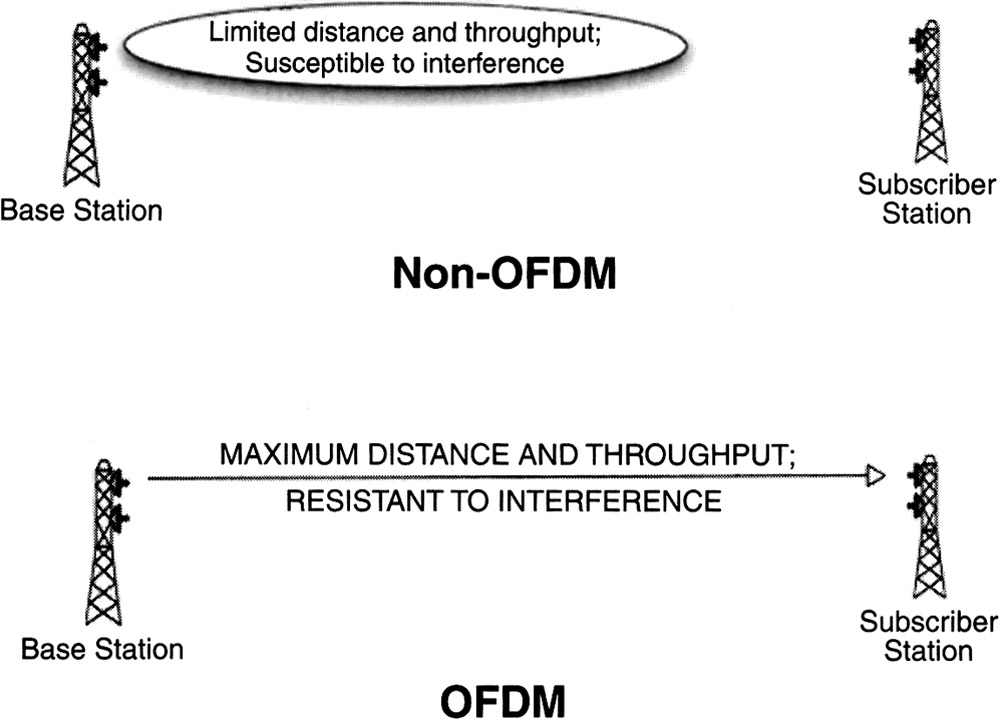
Figure 1: The significance of OFDM: A focused beam delivering maximum bandwidth over maximum distance with minimum interference

TDD and FDD

WiMAX supports both time division duplex (TDD) and frequency division duplex (FDD) operation. TDD is a technique in which the system transmits and receives within the same frequency channel, assigning time slices for transmit and receive modes. FDD requires two separate frequencies generally separated by 50 to 100 MHz within the operating band. TDD provides an advantage where a regulator allocates the spectrum in an adjacent block. With TDD, band separation is not needed, as is shown in Figure 2. Thus, the entire spectrum allocation is used efficiently both upstream and downstream and where traffic patterns are variable or asymmetrical.


Figure 2: A TDD subframe

In FDD systems, the downlink (DL) and uplink (UL) frame structures are similar except that the DL and UL are transmitted on separate channels. When half-duplex FDD (H-FDD) subscriber stations (SSs) are present, the base station (BS) must ensure that it does not schedule an H-FDD SS to transmit and receive at the same time.

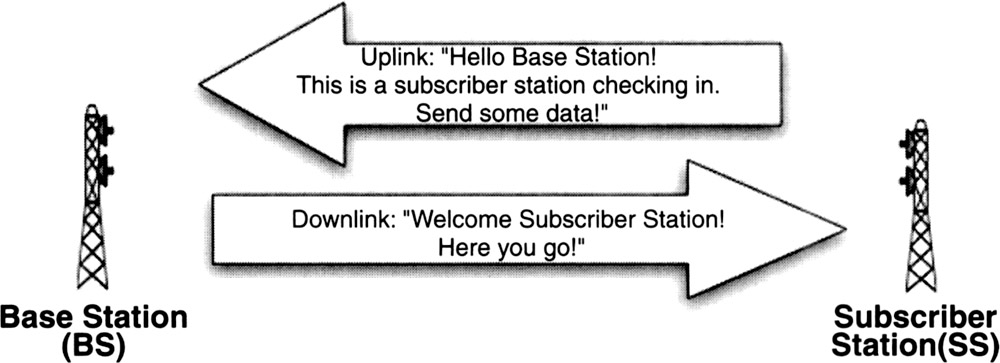
Figure 3 illustrates this relationship.

Figure 3: ULs and DLs between BSs and SSs

Adaptive Antenna System (AAS)

AAS is used in the WiMAX specification to describe beam-forming techniques where an array of antennas is used at the BS to increase gain to the intended SS while nulling out interference to and from other SSs and interference sources. AAS techniques can be used to enable Spatial Division Multiple Access (SDMA), so multiple SSs that are separated in space can receive and transmit on the same subchannel at the same time. By using beam forming, the BS is able to direct the desired signal to the different SSs and can distinguish between the signals of different SSs, even though they are operating on the same subchannel(s), as shown in Figure 4.

Figure 4: AAS uses beam forming to increase gain (energy) to the intended SS.

Wednesday, December 2, 2009

Certification Process | WiMAX Certifications

The WiMAX certification process is the steps, processes and tests which are performed to ensure that products will perform as desired and will reliably interoperate with other devices that are certified.

Testing for WiMAX products can be performed using testing conformance standards. The WiMAX test standards include a protocol implementation conformance statement (PICS), a test suite structure (TSS) and a radio conformance testing (RCT).

A protocol implementation conformance statement proforma is a document that is provided by a company or testing facility that states that the product or system provides and supports a specific set of commands and protocols. The 802.16 system has many capabilities and WiMAX devices typically are designed to support only a limited set of the protocols and capabilities.

A test suite structure (TSS) is a set of testing equipment configurations and procedures that are used to evaluate the operation and performance of products or systems. For the WiMAX system, the TSS performs operational testing of key functions of WiMAX devices including connecting radio links, authenticating, setting up, and changing services.

Radio conformance tests are a set of procedures that are used to evaluate the operation and performance of the radio part of wireless products or systems.

Sunday, November 29, 2009

Service Flows and Classes

WiMAX services are the providing of information transfer to or between users. Information transfer services can have a variety of characteristics that can be selected and varied by the operator. The WiMAX system uses services flows to identify specific transmission characteristics for specific user services and a single user may have multiple service flows. Common sets of service characteristics may be defined by service classes.

Service Flows

Service flows are communication channels (e.g. a stream of packets) that have particular service characteristics associated with the transfer of data. For example, a communication link might have several service flows associated with it; a real time service flow for voice communication, a high-integrity service flow (low error rate) for data file transfer and a best effort service flow for Internet web browsing.

Each service provided on a WiMAX system is associated with a service flow. Service flows are requested, established and ended. When subscriber stations request services, the system can evaluate and negotiate the requested characteristics at any time.

A single WiMAX subscriber station may have multiple service flows for each connection (service flows can be different in different directions). Service flows can be dynamically added, changed and ended.

Service flows are uniquely identified by a service flow identifier (SFID). A SFID is associated with a specific connection identifier to determine the service characteristics a specific user will receive on that particular device

Related Posts with Thumbnails